

ComPassion Projects: Leveraging AI for Critical Thinking

As Artificial Intelligence (AI) becomes more prevalent and part of our daily life in education, I am challenged to incorporate its benefits while maintaining authentic cognitive engagement. I have developed a framework that utilizes AI as an essential component in developing student-led “ComPassion” projects to help make their world a better place. Similar to how trees give us “oxygen” to fuel our lives, a framework titled PLANT TREES has helped my students' ideas, or seeds of passions, grow into a mission to inform and help others.
Embedded in my English Language Arts (ELA) instructional time, I encourage my students to use a research station with the PLANT TREES model. It has organically welcomed the use of AI as a “partner” in generating knowledge and curating understanding around a topic. For instance, as we read a curriculum-based text on the different perspectives on the Revolutionary War, a student may raise more questions, show greater curiosity about the role of horses in wartime, and want to delve deeper into this topic. This example is shown through the model below.
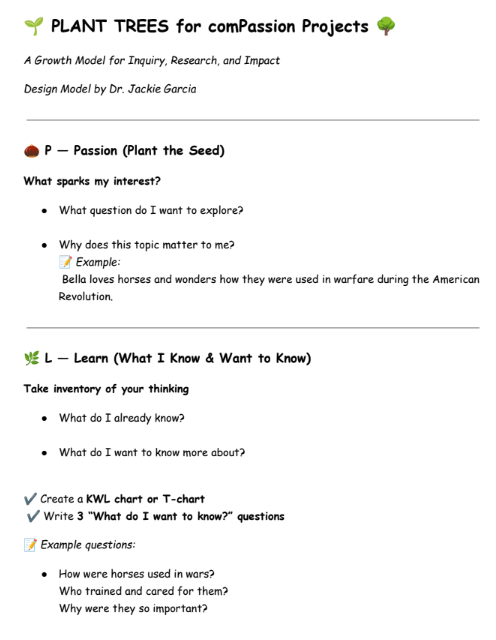
PLANT TREES Model for ComPassion Projects
PASSION | Plant the Seed
What sparks my interest? Question about what you would like to know more about, given a “seed” or idea. Why does this pique my interest? For example, my student, Bella, has a passion for horses and is interested in how they were an essential component of warfare during the American Revolution, a broader topic of study in our ELA curriculum. Or, perhaps my student, David, is interested in how the installation of the cannon influenced wartime outcomes.
LEARN | What I know and want to know
What have I already known or learned? Similar to a KWL organizer, for this step, students will take inventory of what they already know and what they want to know about their areas of passion/interest; what they “want to know” will guide the next step. Students can use the included Google Slides as a guide, notepaper, or any application. Three “what do I want to know” questions. A student, Bella, may annotate in her notebook a T chart: On the left, a list of what she knows about the importance of horses and how they served as modes of transportation throughout history. In contrast, on the right side, different areas of inquiry, such as “How were horses used during times of war in American history?” “Who trained or cared for horses during this time?”
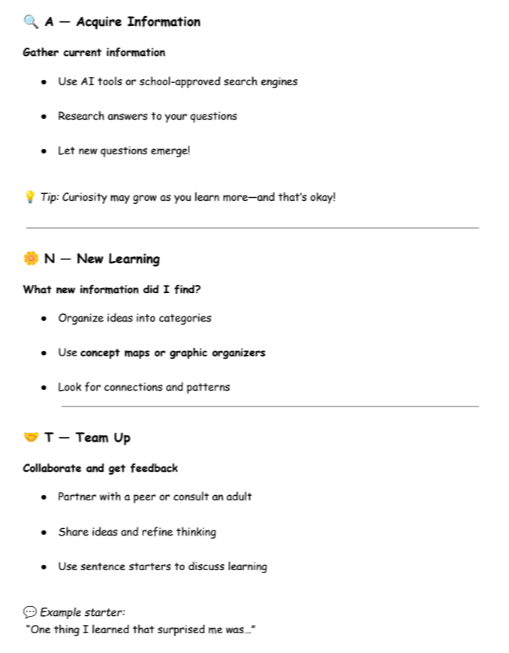
ACQUIRE | Gather current information
Access current information using an AI tool or other search engines available through a school entity. Students' questions could be entered into various search engines to obtain preliminary information. In this stage, different ideas or questions may emerge.
NEW | What new information did I find?
This stage calls for the learner to organize new information and content into broader categories. Concept mapping can be a helpful strategy for shaping their understanding and making connections.
TEAM UP | Collaborate and get feedback
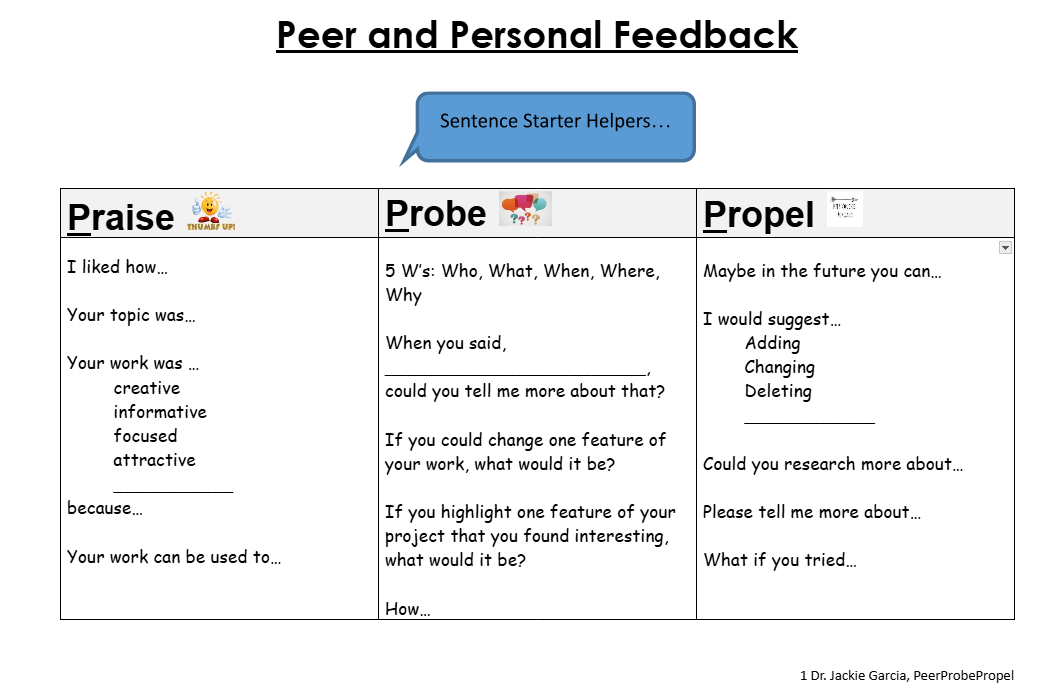
Partner or consult with another peer or adult. There may be other experts in the field or other students with similar interests. When we collaborate with others, we can sharpen our focus and narrow our topic even further. I provide students with sentence starters to help them review information with others and give feedback.
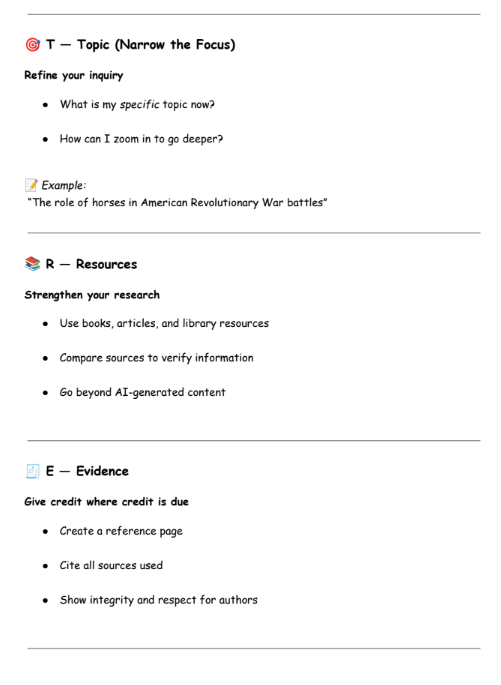
TOPIC | Narrow the focus
Based on the previous work, students can refine and refocus on what an important topic to pursue will be. What is my narrower topic?
RESOURCES | Strengthen your research
What further exploration will be needed to triangulate findings from either the AI-curated information, such as published books or articles, to support conclusions? A visit to the library or the use of published resources can be included to support this information.
EVIDENCE | Give credit where credit is due
Once the resources are pulled in, students will devise a reference page as a means to cite their sources. Similar to a formalized reference page, this will be included to support the content curation. Emphasizing the importance of giving credit to authors and others in the field is highly regarded and demonstrates integrity throughout the process.
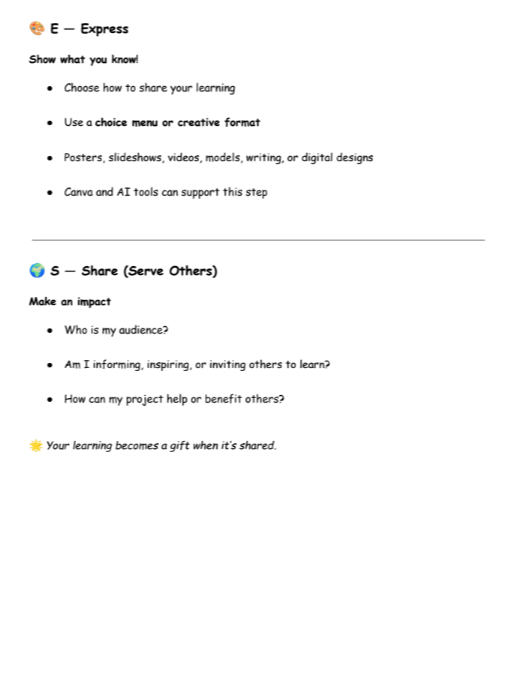
EXPRESS | Show what I know
At this stage, students determine how they will express their newly adopted expertise through a differentiated project. Students will have agency in how they choose to create this project. A differentiated choice menu can be provided, or students can use AI to help with this stage, as well. Canva is a helpful platform, as it offers a range of options for presenting content.
SHARE | Serve others
As students crystallize their newfound knowledge, they are expected to share their answers to their original “seeds” through a project that will serve others. Students will consider their audience and whether they will share their research to inform, inspire, or invite their audience into the final project’s conclusions. The production of work will require students to demonstrate how newly developed knowledge can impact and benefit others.
Recommendations for Use with Students
This model provides a roadmap for purposefully integrating AI while elevating social consciousness and student agency. When these work harmoniously, student engagement and joy increase while rigorous academic standards are met across classrooms. This may be a mindset shift for many of your students, so at first, if it is slowly embraced or if the framework takes some time to gain momentum, give yourself and your students grace. Feel free to access a PDF of the PLANT TREES model (images below as well).
Through my experiences, strategies that have been proven helpful are providing a visual pathway for my students to reference in my classroom. This provides an ongoing reminder of the full process. I point out to my students that the goal is to complete their project within a two-week timeframe, while allowing flexibility for adjustments. Progress is sought over perfection. When students move into the presentation step, I share with students ahead of time that there will be a 3-minute time limit to present their project to their audience. A sand timer is used as a visual aid. This parameter helps students share more concisely and makes it easier to embed it during a Morning Meeting or a Community Closure. After students share, a Peer Reflection is offered through a “Praise, Probe, and Propel” to aid in audience participation.

About the Author
As a life-long learner, Dr. Jacqueline D. Garcia believes that in order to inspire “the head” it’s essential to nurture “the heart” of her students. Centennial School District of Bucks County, Pennsylvania has been her home for over twenty-three years. She has also had the pleasure of serving as a graduate adjunct professor at Holy Family University in the areas of Special Education and Reading for over fifteen years.
